
Parenting Doesn't Come With an Instruction Manual
You love your child. That doesn't mean you always know what to do.
Maybe conversations that used to be easy now turn into arguments. Your teen wants more independence, but you're still responsible for keeping them safe. You try giving space and then wonder whether you're giving too much.
Wayfinder offers online parenting support throughout Texas to help parents understand their child, strengthen communication, establish appropriate boundaries, and feel more confident navigating the challenges of raising a teenager.
You've explained it, reminded them, taken things away, tried being stricter, tried being more understanding, and tried giving them space. Somehow you're having the same argument again.
Sometimes the problem isn't that you haven't tried hard enough. The strategy may simply not fit what's happening with this particular child in this particular situation.
"I've Tried Everything."

Understanding and Boundaries Can Exist Together
Behavior tells us something. That does not mean inappropriate behavior should be ignored or excused.
A teen struggling with ADHD may need a different approach to homework than a sibling. A teen experiencing anxiety may avoid something because avoidance temporarily makes the anxiety disappear. Another teen may simply be testing a boundary.
Understanding why something is happening helps us decide how to respond.

No Two Children Need Exactly the Same Parent
Even siblings growing up in the same home can have very different personalities, strengths, challenges, and ways of experiencing the world.
Instead of memorizing one parenting formula, we look at what's happening, what your child may be communicating, what you've already tried, how your child responded, and what your individual child needs from you in that situation.
Parenting Support Can Help With
-

Communication
Making room for connection and boundaries.
-

ADHD
Supporting your child through discomfort without automatically rescuing them from every difficult feeling.
-

Anxiety and avoidance
Overthinking, avoidance, reassurance seeking, school worries, social fears, panic, and persistent "what if?" thinking.
-

Boundaries and Expectations
Creating clear, realistic, consistent expectations.
-

Family Conflict
Identifying patterns beneath the latest argument.
-

Parent confidence
Reducing constant second-guessing about when to push, when to pause, and when to give space.
The Small Moments Matter
If you tell your child, "Give me five minutes and then I'll come see what you wanted to show me," the important part is coming back.
Small experiences of follow-through can communicate: My parent means what they say. They're busy sometimes, but they come back. What matters to me matters to them too.
And when you forget — as every parent eventually will — repair matters: "I'm sorry. I told you I'd come back and I forgot." Parenting is not about never getting it wrong. Connection, boundaries, consistency, and repair can all exist together.
Triple P – Positive Parenting Program
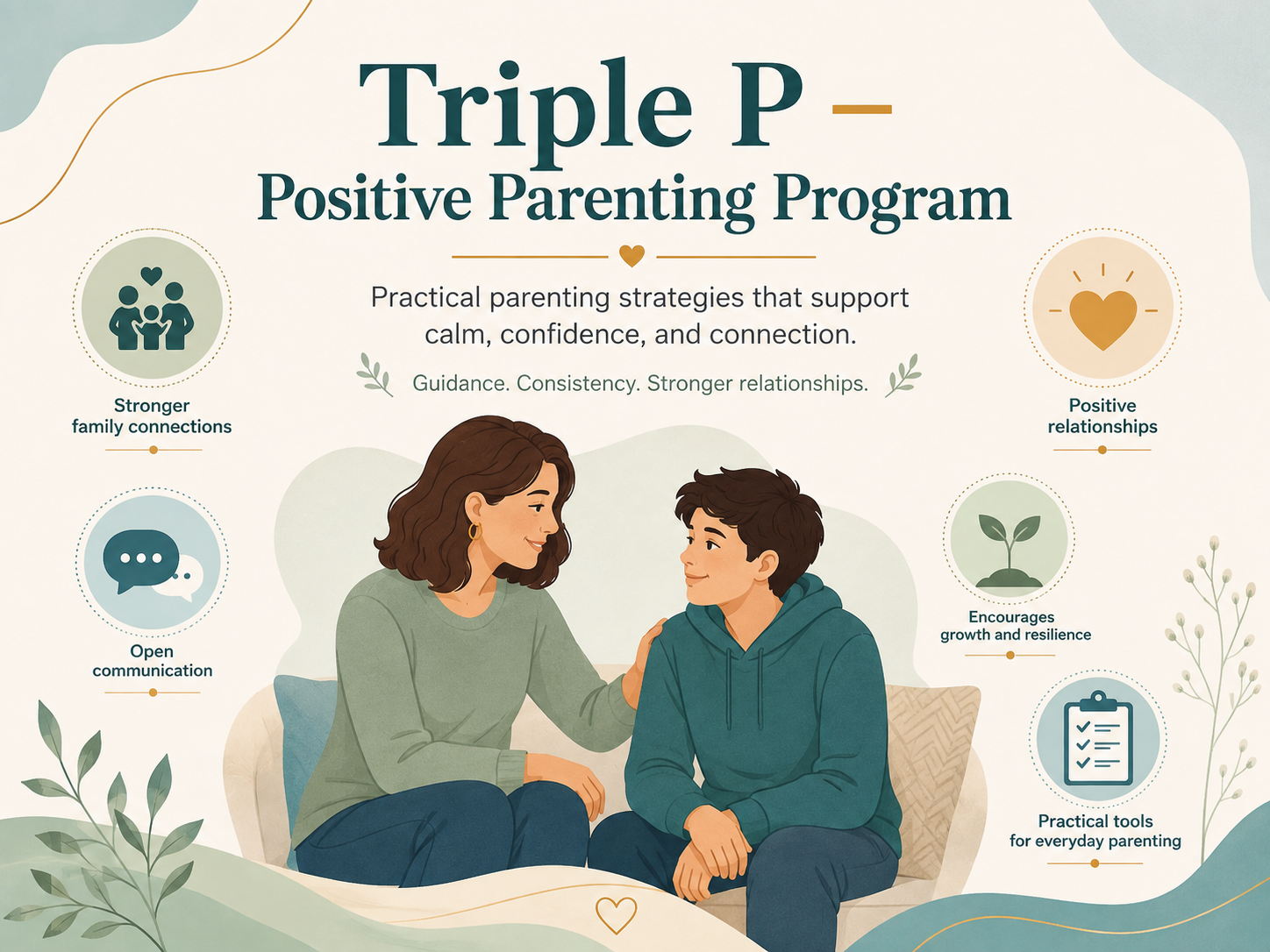
Triple P is one of my primary approaches to parenting support. Despite the name, it is not about telling parents to simply "be more positive."
It provides practical, evidence-based strategies for strengthening relationships, encouraging helpful behavior, managing difficult situations, building independence, creating realistic expectations, and taking care of yourself as a parent.
Triple P gives us tools. Our conversations help determine which tools actually fit your child and family.

What If I'm the One Who Loses My Cool?
Parents get overwhelmed. Parents become frustrated. Parents sometimes say things they wish they'd said differently.
The goal is not to become a parent who never makes a mistake. A more useful question is: What do I do next when I don't handle something the way I wanted to? Sometimes the answer is a clearer boundary. Sometimes it's a different strategy. Sometimes it's repair: "I didn't handle that well. Can we try that conversation again?"
Parent Support Doesn't Mean Parent Blame
If things are difficult at home, I'm not interested in deciding who's the problem — not your teenager and not you.
We look at the pattern together. Parents usually reach out because they've been trying hard to help someone they love. Sometimes the strategies that used to work stop working, or anxiety, ADHD, depression, school pressure, developmental changes, or family stress complicate things.
When Your Teen Is Also in Therapy
Depending on treatment needs, a parent may join the first or last 10–15 minutes of a teen's session. We can review strategies, help you understand what your teen is learning, discuss implementation at home, and address communication patterns.
Parent involvement and teen privacy do not have to be opposites. We work toward an appropriate balance.
Is your teen the one who needs support directly? See Online Teen Therapy.
Good Parents Still Need Support
Your teenager does not need a perfect parent. They need someone willing to keep learning who they are, provide boundaries while maintaining connection, listen, lead when necessary, and repair mistakes.
Asking for support does not mean you've failed.

Ready for the Next Step?
Not sure whether therapy is the right next step? Let's start with a conversation.
Virtual therapy available throughout Texas. Online consultation booking is the easiest way to get started; phone and email are also available.
Wondering how online sessions actually work, or what they cost? See Online Therapy in Texas.