
Virtual Counseling for School Stress: A Parent's Guide
Explore how virtual counseling for school stress helps teens build coping skills, improve grades, and feel heard. Find signs it's time to start.
When your teen starts dreading Mondays, complaining of headaches before exams, or snapping at everyone after school, it is easy to chalk it up to a phase. But persistent school stress often signals something deeper, and virtual counseling for school stress has become a practical first step for many families. At Wayfinder Counseling Therapy, we help parents across Texas recognize when everyday pressure turns into academic burnout and connect their teens with support that fits their lives.
Virtual counseling is a flexible, effective way for students to meet with a licensed mental health professional from home, removing commute time and the stigma of walking into an office. This guide covers the warning signs, how online sessions work, and practical steps to support your teen.
Signs of Academic Burnout in Teens
Academic burnout builds slowly, and the warning signs often look like typical teenage behavior at first. The clearest signal is a shift in attitude: a student who once cared about grades stops trying, or one who loved school now finds reasons to avoid it.
Common signs include a drop in academic performance, frequent physical symptoms like stomachaches or fatigue, withdrawing from friends or family, increased irritability, changes in sleep, or a loss of interest in hobbies. Test anxiety is another red flag, especially when it causes your teen to freeze up or panic despite being prepared.
A common mistake is waiting to see if the behavior "fixes itself." If these signs persist for more than two weeks, it is worth exploring professional support. Early intervention prevents a rough semester from turning into a pattern of avoidance that follows your teen into adulthood.
What Virtual Counseling for School Stress Looks Like
Virtual counseling for school stress connects your teen with a licensed therapist through secure video sessions, typically lasting 45 to 50 minutes. The format mirrors traditional talk therapy, but the home setting often helps teens open up faster.
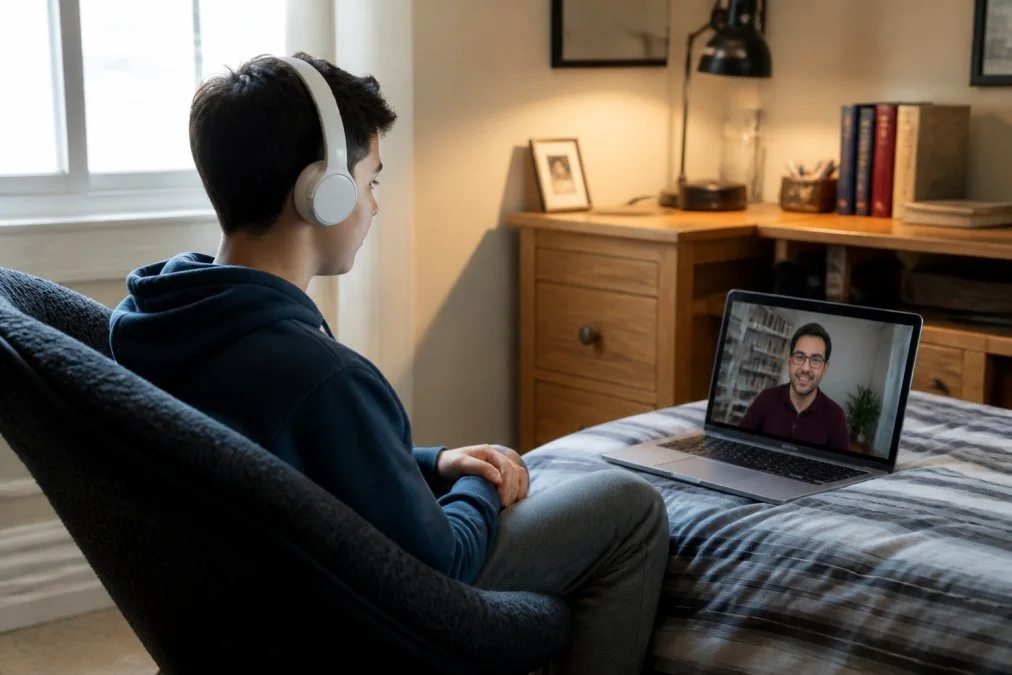
Sessions focus on building coping mechanisms for anxiety, improving time management, and addressing the root causes of stress, whether that is social pressure, academic expectations, or family dynamics. The therapist works with your teen to identify unhelpful thought patterns and replace them with practical strategies for use between sessions.
The First Sessions: What to Expect
The first session is primarily about building rapport. Your teen will talk about their daily routine, what triggers their stress, and what they hope to change. The therapist asks questions to understand their world, not to diagnose them on day one. Parents may share observations, though the therapist will spend most of the time connecting directly with your teen.
By the third or fourth session, a clearer picture emerges: your teen may start using new language to describe their feelings, or share a technique they tried that worked. That is the sign the therapeutic alliance is forming.
How Virtual Counseling Differs from In-Person Therapy
The core work of therapy, building rapport, identifying patterns, and developing coping skills, is the same whether it happens in an office or over video. The differences are practical, and for many teens, they are advantages. But the transition is not always seamless; acknowledging the 'digital divide' and the discomfort some students feel with screen-based therapy is the first step to making it work.
The Digital Divide and Hesitancy
For a student who has only known in-person therapy, the shift to a screen can feel impersonal or awkward. They might worry about being overheard, feel self-conscious seeing their own face on camera, or miss the subtle non-verbal cues of a shared physical space. A common pattern is for teens to report that the first virtual session feels 'weird,' but that this feeling fades by the second or third session.
A good therapist will address this head-on. They might start a session by asking, 'What is different for you about talking this way?' or 'Is there anything about your space that makes you feel less comfortable?' This normalizes the experience and turns the technology into a tool rather than a barrier.
The 'Therapy Space' Problem
In-person therapy creates a clear boundary between 'therapy space' and home life. In virtual counseling, your teen sits in the same chair where they play video games or do homework. Some teens find this makes it easier to relax; others need help transitioning out of 'school mode' before a session.
To bridge this gap, a therapist might coach your teen to create a simple pre-session ritual, such as:
Taking a five-minute walk around the block before logging on.
Changing out of their school clothes into something comfortable.
Having a glass of water and a notebook ready before the session starts.
Spending one minute doing a grounding exercise, like naming five things they can see.
This ritual signals to the brain that a different kind of conversation is about to happen, which helps the student engage more fully.
Privacy in a Shared Home
The biggest practical difference is privacy. A reputable provider uses HIPAA-compliant platforms, meaning your teen's sessions are protected the same way they would be in a clinic. Confidentiality rules still apply: what your teen shares in session stays between them and the therapist, except in cases of safety concerns.
The technical compliance is only half the equation; the other half is the physical environment. Before the first session, have a direct conversation with your teen about where they feel most comfortable. A bedroom with a locked door is ideal for many, but not all teens want their therapist to see their personal space. A quiet corner of a living room can work if the rest of the family agrees to stay out of the room for the full session.
Watch Out If your teen is worried about a sibling or parent overhearing, do not dismiss the concern. Offer to test the audio from outside the room to confirm the conversation is not audible. This simple check builds trust and helps your teen feel safe speaking freely.
When Virtual Is Not the Right Fit
Virtual counseling is not a universal replacement for in-person care. If your teen is experiencing a severe crisis, showing signs of self-harm, or struggling with a condition that requires intensive, in-person intervention, a higher level of care is necessary. Virtual counseling works best for managing stress, anxiety, and academic burnout, not for emergencies. If you are unsure, ask the therapist directly during the initial consultation whether they believe virtual sessions are clinically appropriate for your teen's specific situation.
How to Help Teens with Anxiety at Home
Professional support works best when reinforced at home. Many parents ask us how to help teens with anxiety between sessions, and the answer starts with changing how you respond in the moment.
When your teen is mid-panic or spiraling, do not try to reason them out of it. Instead, validate the feeling first: "That sounds really overwhelming." Once they have calmed down, which often takes a few minutes of deep breathing, you can
Practical techniques that work well at home include:
Teaching your teen to name their emotion ("I am feeling anxious about the history test") to reduce its power
Helping them break overwhelming tasks into small, 15-minute chunks
Modeling calm behavior when they are stressed, since anxiety is contagious in both directions
Creating a predictable evening routine that protects sleep, since exhaustion amplifies anxiety
Pro TipThe most powerful phrase you can use with an anxious teen is "Tell me more about that." It keeps the conversation open without rushing to fix the problem, which builds their confidence in handling it themselves.
The goal is not to eliminate stress, which is impossible, but to build resiliency. Teens who learn to manage moderate stress now carry that skill into college and the workplace.
Setting Up for Success: Tech and Privacy
A successful virtual session depends on three things: a stable connection, a private space, and working audio. You do not need fancy equipment, a laptop or tablet with a camera, a decent internet connection, and a quiet room are sufficient. Here is how to troubleshoot the most common issues before they eat into session time.
Building a Distraction-Free 'Therapy Space'
The physical environment matters more than the technology. The goal is to create a space that feels both private and neutral. A bedroom with the door closed works for most families, but a living room corner can work too if the rest of the family stays quiet.
Before the first session, walk through the space with your teen and check for these common distractions:
Visual clutter: A messy background can be distracting and make your teen feel self-conscious. A blank wall or a tidy bookshelf works best.
Phone notifications: Put the phone in another room or turn on 'Do Not Disturb' mode. A buzzing phone derails focus.
Pets: A dog barking or a cat jumping on the keyboard is a guaranteed interruption. Plan for pets to be in another room.
Foot traffic: If the space is near a hallway or kitchen, post a simple sign on the door that says 'Session in Progress.' This signals to the rest of the household that the space is off-limits.
The Five-Minute Tech Test
Before the first session, test the video platform together. A quick five-minute test run prevents the awkward 'can you hear me now' delay that eats into session time:
Camera angle: Place the laptop on a stack of books so the camera is at eye level. A camera pointing up at the chin is unflattering and distracting.
Lighting: Make sure the light source is in front of your teen, not behind them. Backlighting turns the screen into a dark silhouette.
Audio: Test the built-in microphone. If there is an echo, switch to a pair of wired earbuds with a mic. Bluetooth headphones can introduce latency.
Internet stability: Run a quick speed test. A download speed of at least 10 Mbps is generally sufficient for a stable video call. If the connection is weak, close other browser tabs and pause any large downloads.
Platform familiarity: Log in to the session link a few minutes early to confirm the platform loads correctly and that your teen knows how to mute and unmute themselves.
Troubleshooting Common Issues
Even with a solid test, problems can arise. Here is how to handle the most common ones:
Video freezing or lagging: Ask your teen to turn off their camera temporarily and continue with audio only. This often stabilizes the connection.
Audio echo: This is usually caused by both the computer speakers and the microphone picking up sound. Using headphones eliminates the echo almost entirely.
Background noise: If you hear traffic or household sounds, the therapist may suggest muting the microphone when the teen is not speaking. This is a standard practice in virtual sessions.
Pro TipIf your teen is nervous about the technology, do a practice call with a friend or family member first. The goal is to make the video platform feel as normal as a text message by the time the first real session starts.
Watch OutDo not hold virtual counseling sessions in a car or a public space like a coffee shop. Background noise and the risk of others overhearing undermine both the privacy and the quality of the session. Your teen needs to feel safe speaking freely.
Navigating Insurance and Sliding Scale Fees
One of the biggest barriers to starting virtual counseling is figuring out how to pay for it. Many parents assume their insurance will not cover online therapy, but the process is simpler than you might think.
Start by calling the number on the back of your insurance card and asking three specific questions:
'Does my plan cover telehealth or virtual counseling sessions?'
'Is there a difference in my copay for telehealth versus in-person visits?'
'Do I need a referral from a primary care physician before the first session?'
Many major insurance plans now cover telehealth at the same rate as in-person visits, but this varies by state and plan. If your insurance does not cover virtual counseling, or if you do not have insurance, ask the provider about pricing. Wayfinder Counseling Therapy operates on a private pay model.
How to Talk to Your Teen About Therapy
Bringing up therapy with a resistant teen is one of the hardest conversations a parent can start. Avoid framing therapy as a punishment or a sign that something is "wrong" with them.
Start with curiosity, not conclusions. "I have noticed you seem more stressed lately. How are you feeling about school?" gives your teen room to respond without feeling attacked. If they open up, listen without interrupting. If they shut down, do not push; simply say you are there when they want to talk.
When you introduce the idea of counseling, focus on what is in it for them. Teens respond to the promise of feeling better, not to lectures about their grades. Framing it as "a coach for your brain" or "someone neutral to talk to who is not a parent or teacher" often lands better than calling it therapy.
Acknowledge their objections honestly. If your teen says "I tried therapy and it did not work," validate that experience. You can explain that finding the right therapist makes a difference, and that this is a different person with a different approach. For teens who are bilingual or more comfortable in one language, ask about that preference upfront. At Wayfinder Counseling Therapy, our services are available in both English and Spanish, and matching your teen with a therapist they connect with is the single biggest predictor of success.
Conclusion: Finding the Right Fit
School stress does not have to define your teen's experience. Virtual counseling offers a practical, private way to help them build the skills they need to manage anxiety, improve communication with your family, and find their footing again. The right therapist makes all the difference.
If you are watching your teen struggle and feeling unsure where to turn, start with a conversation. At Wayfinder Counseling Therapy, we offer a free 15-minute consultation to help you determine if our approach fits your family's needs. Our virtual sessions are accessible throughout Texas, and our bilingual, human-centered approach is designed for teens, young adults, and parents navigating anxiety, ADHD, and school stress. Book your consultation and take the first step toward helping your teen feel like themselves again.
Frequently Asked Questions
What are the signs that a teen needs counseling for school stress?
Watch for changes in sleep, appetite, or grades. If your teen seems constantly irritable, withdraws from friends and family, or complains of physical symptoms like headaches or stomachaches before school, it may be more than just a bad week. A sudden drop in academic performance or refusing to go to school are clearer indicators. If these signs of academic burnout in teens last more than two weeks, a consultation with a licensed mental health professional can help you understand what is driving the behavior.
Does virtual counseling for school stress comply with HIPAA privacy standards?
Yes. Licensed therapists in the U.S. are required to use telehealth platforms that are HIPAA-compliant. This means the video software includes encryption and secure data handling to protect your privacy. Before starting, you can ask your counselor which platform they use and how they manage confidential records. Your teen also has the right to a private space during sessions, which helps build trust and openness in the virtual environment.
How does virtual counseling differ from in-person therapy for students?
The main difference is the setting. Virtual counseling removes travel time, which makes it easier to fit sessions into a busy school and activity schedule. Many teens feel more at ease talking from their own room, which can speed up building a therapeutic alliance. The counselor uses evidence-based techniques to address test anxiety and stress management. The effectiveness depends more on the counselor-client relationship than on the delivery method.
How can parents prepare their teen for their first virtual therapy session?
Start by picking a quiet, private spot with a reliable internet connection and a charged device. Encourage your teen to use headphones to keep the conversation confidential. Let them know the first session is about getting to know the counselor, so there is no pressure to have all the answers. Reassure them that what they say is confidential unless they are in immediate danger. This helps them feel safer and more willing to participate.

Improving Family Communication With Teens: 7 Tips
Learn practical ways of improving family communication with teens, from active listening to repair scripts. Start building a stronger connection today.
Why Improving Family Communication With Teens Feels So Hard Right Now
Improving family communication with teens often feels like a battle because you are negotiating with a brain undergoing its second most rapid period of development after infancy. The prefrontal cortex, responsible for impulse control, long-term planning, and emotional regulation, is not fully wired until the mid-20s. Meanwhile, the limbic system, the brain's emotional center, is running at full capacity, making teens more reactive to perceived slights and more sensitive to social rewards. This mismatch is why a calm request about a messy room can trigger a disproportionate outburst.
But the modern friction points go beyond biology. The average teen in the United States spends nearly 9 hours a day on screens, not including schoolwork, according to Common Sense Media. This digital immersion rewires social expectations: a teen who has just been humiliated in a group chat may come to the dinner table primed for defensiveness. When you ask "How was school?" and get a grunt, it is rarely about rejection; it is often because their social battery is drained from navigating a complex digital social landscape that didn't exist for you at their age.
Another overlooked factor is the asymmetry of power and time perception. To a parent, a missed curfew is a safety issue; to a teen, it is an arbitrary restriction on their emerging autonomy. This is not just stubbornness, it is a developmental drive to individuate. Psychologist Lisa Damour, author of The Emotional Lives of Teenagers, notes that conflict with parents is actually a sign of healthy development, as it signals the teen is practicing asserting their own identity. The problem is not the conflict itself; it is the lack of a framework to manage it productively.
The good news is that a communication breakdown is not a permanent state. It is a pattern, and patterns can be changed with the right techniques and a commitment to consistency. This guide covers seven practical strategies to rebuild connection, manage conflict, and create psychological safety at home, including the digital boundaries most guides ignore and the repair scripts for when things have already blown up.
Key Takeaway Understanding the neurological and digital context of teen communication helps you depersonalize the conflict. Your teen's grunts and eye rolls are not a verdict on your parenting, they are a symptom of a developing brain navigating a hyper-connected world.
Active Listening Techniques for Parents That Actually Get Teens Talking
Active listening is the single most effective tool for opening up a conversation with a teenager, and it involves more than just staying quiet while they speak. True active listening requires you to set aside your own agenda and give your full attention to what your teen is saying, both verbally and through their body language. This means putting your phone down, making eye contact, and resisting the urge to interrupt with advice or a lecture.
Instead of planning your next response, focus entirely on their words and the emotions behind them. A common mistake is to jump straight into problem-solving mode, which immediately shuts down the dialogue because teens feel like they are being managed rather than heard.
Pro Tip Reflective listening is a powerful way to show you are engaged. After your teen finishes a thought, summarize it back to them using their own words: "So you're saying that Mr. Davis singled you out in class and it made you feel embarrassed?" This confirms you were listening and validates their perspective without adding your own judgment.

Validating Emotions Without Fixing the Problem
Emotional validation is the practice of acknowledging your teen's feelings as legitimate and understandable, even if you do not agree with their interpretation of events. When a teenager is upset about a low grade or a social snub, the instinct to minimize the problem with phrases like "it's not a big deal" can feel like a direct attack on their reality. Instead, try to name the emotion you observe and give them space to feel it without rushing to a solution.
This approach builds emotional regulation skills because it teaches teens that feelings are manageable and temporary, not overwhelming threats. The goal is not to agree with them but to show empathy for their experience. By creating a supportive environment where they can express frustration without fear of correction, you strengthen the parent-teen relationship and build the trust needed for future conversations.
Parenting styles that rely on immediate correction often miss this crucial step, inadvertently teaching teens to hide their feelings rather than process them.
Teen Communication Scripts for Conflict Moments
Conflict resolution is where most family communication strategies fall apart because emotions are high and impulse control is low. When a blowup happens, having a pre-planned script can help you de-escalate the situation and model healthy behavior. Instead of reacting to a slammed door or a disrespectful tone with equal heat, try using a calm, structured response that acknowledges the emotion while setting a boundary.
Consider these phrases for tense moments:
"I can see you are really angry right now, so I am going to give you some space. We can talk about this in 20 minutes when we are both calmer."
"I want to hear what you have to say, but I can't do it when you are yelling. Let's try that again."
"You are right that I don't understand how you feel about this. Help me understand."
These scripts work because they separate the person from the problem. They validate the emotion, set a boundary against disrespectful behavior, and open the door for collaborative problem solving later. Effective dialogue during conflict is less about winning the argument and more about preserving the connection so you can find a solution together.
Setting Digital Boundaries That Respect Their Independence
Digital communication boundaries are a modern frontier in parenting that many guides overlook, yet they are often the source of daily friction. For today's teens, the phone is their primary social lifeline, so confiscating it as punishment can feel like isolating them from their entire support network. Instead of focusing on screen time limits alone, try negotiating boundaries around specific behaviors, such as no phones at the dinner table or no scrolling during family conversations.
This negotiation process is a form of trust-building because it treats the teen as a partner in creating the rules rather than a subject of them. Discuss the "why" behind the boundaries, such as the value of undivided attention for connection, and be willing to compromise on the specifics. Mutual respect is the foundation here: if you expect them to put the phone down when they talk to you, you must model the same behavior when they are speaking.
Repairing Broken Communication After a Blowup
Every family has moments they wish they could take back, and the ability to repair the relationship after a conflict is more important than avoiding the conflict itself. A blowup does not have to define the parent-teen relationship; leaving it unaddressed does. Repair begins with taking responsibility for your own part in the argument, which demonstrates accountability and models emotional regulation for your teen.
Book a free 15-minute consultation →
Moving forward, a simple apology can be incredibly powerful: "I am sorry I yelled at you. I was frustrated about the mess, but I should not have taken it out on you." This does not excuse their behavior, but it breaks the cycle of blame and defensiveness. After the apology, give them space to respond and listen without interrupting. This process rebuilds trust and shows that conflict can be survived, which is a core benefit of family therapy approaches in a safe environment.
Watch OutA common mistake is to apologize and immediately bring up their part of the argument, saying something like "I'm sorry, but you started it." This invalidates the apology and restarts the conflict. Keep the focus on your own actions and allow their accountability to come naturally later.
The Benefits of Family Therapy for School Stress and Beyond
When communication patterns are deeply entrenched, or when underlying issues like anxiety and ADHD are fueling the conflict, professional support can make a significant difference. The benefits of family therapy for school stress extend beyond just improving grades; therapy provides a neutral space where both parents and teens can express themselves with the guidance of a trained professional.
What actually happens in family therapy?
Most practitioners use a blend of evidence-based approaches. Structural Family Therapy, developed by Salvador Minuchin, focuses on realigning the family hierarchy and boundaries, helping parents reclaim authority without being authoritarian, and helping teens feel heard without controlling the household. Emotionally Focused Therapy (EFT) , pioneered by Sue Johnson, works on attachment bonds, helping family members articulate underlying emotions (like fear of failure or fear of disconnection) rather than the surface anger. Cognitive Behavioral Therapy (CBT) techniques are often woven in to help teens and parents identify and reframe automatic negative thoughts like "I'm always the bad guy" or "My parents will never trust me."
A typical course of family therapy is not open-ended. Many therapists work in 8-12 session blocks, with goals set in the first two sessions. A common mechanism is the enactment: the therapist asks family members to have a conversation about a real issue in the room, then intervenes in real-time to redirect destructive patterns and coach new ones. This is not abstract advice, it is live, coached practice.
When to seek help vs. when to try repair at home first
If the conflict is characterized by recurring verbal aggression, stonewalling that lasts more than a few days, or if your teen has withdrawn from activities they used to love, professional help is warranted. The American Academy of Pediatrics recommends seeking professional support if communication breakdowns are accompanied by changes in sleep, appetite, or academic performance lasting more than two weeks.
However, before you book a session, there is a critical step you can take at home: structured repair. Many families skip this and go straight to therapy, but a guided repair attempt can sometimes reset the dynamic. Here is a script for initiating repair after a major blowup:
Schedule it explicitly: "I know things got heated last night. I'd like to talk about it for 15 minutes tonight after dinner. No phones."
Open with your own accountability: "I want to apologize for raising my voice. That wasn't fair to you, regardless of what happened."
State the impact, not the blame: "When you slammed the door, I felt shut out and worried."
Ask for their perspective without defending: "I want to understand what was going on for you. Can you help me see it from your side?"
Close with a forward-looking question: "What is one thing I could do differently next time that would help?"
The goal here is not to resolve the original issue (the curfew, the grade, the mess). The goal is to re-establish that you can have a difficult conversation without the relationship fracturing. If this structured repair fails twice, meaning the conversation devolves into yelling or silence both times, that is a strong signal that a neutral third party is needed.
Pro TipWhen choosing a family therapist, ask about their experience with adolescent development and whether they use a structured modality like EFT or Structural Family Therapy. Also ask about telehealth options, many families find that teens open up more easily when they are in their own space on a screen rather than in a clinical office.
Building a Communication Habit That Lasts
Improving family communication with teens requires moving from occasional deep talks to consistent, low-pressure habits that create ongoing connection. A common approach is to establish a weekly check-in, such as a walk, a drive to get coffee, or a shared activity where conversation can happen naturally without forced eye contact. These shared activities lower the stakes and make it easier for teens to open up about their lives.
Consistency matters more than intensity. A 10-minute conversation each day where you practice active listening and non-judgmental engagement will build a stronger parent-teen relationship than a single hour-long lecture every month. Try to integrate these communication strategies into your daily routine until they become second nature, and remember that setbacks are normal. If you need additional support, Wayfinder Counseling Therapy offers virtual sessions focused on teen anxiety, ADHD, and parent support, all in a bilingual, human-centered environment.
Rebuilding family communication with teens is a gradual process that demands patience, empathy, and a willingness to change your own reactions first. The strategies in this guide can help you create a foundation of trust and mutual respect, but some challenges are too complex to solve alone. Wayfinder Counseling Therapy specializes in virtual support for teens and parents across Texas, offering a safe space to improve communication and emotional regulation. Book a free 15-minute consultation to see how we can help your family find its way forward.
Frequently Asked Questions
How can I get my teenager to open up to me?
Start with active listening techniques for parents: put your phone down, make eye contact, and resist the urge to give advice immediately. Teens stop talking when they expect a lecture or a judgment. Try asking one open-ended question during a low-pressure moment, like in the car or while making dinner. If they share something small, acknowledge their feelings first. A short response such as "That sounds frustrating" often goes further than a long list of solutions.
What are common barriers to effective communication with teens?
The biggest barriers are criticism, immediate problem-solving, and bringing up past mistakes during a current discussion. Teens also shut down when they feel interrogated with rapid-fire questions. Digital distractions, like a parent checking a phone mid-conversation, signal that they aren't a priority. For teens with ADHD or anxiety, processing time may be slower, so silence after a question is not rejection. Give them space to formulate an answer without filling the gap yourself.
When should parents seek professional support for family communication issues?
If conversations regularly escalate into shouting matches, if your teen withdraws completely for weeks, or if school stress is causing noticeable changes in sleep, appetite, or grades, professional help can make a real difference. Family therapy for school stress provides a neutral space where each person feels heard. A counselor can teach conflict resolution skills and teen communication scripts tailored to your family's patterns. Seeking help early is a proactive step, not a sign that you have failed as a parent.
What is the 7-7-7 rule for parenting?
The 7-7-7 rule is a guideline suggesting that couples take a getaway every 7 months, a weekend away every 7 weeks, and a date night every 7 days. While it is designed for romantic relationships, the principle applies to family communication: dedicated, undistracted time strengthens connection. For parents of teens, this might look like a weekly walk together or a monthly one-on-one outing. Consistent shared activities create natural openings for conversation without the pressure of a formal sit-down talk.

About the Author
Julio Alberto Ibarra is a licensed professional counselor (LPC) with over 10 years of experience supporting clients in Texas. He specializes in working with adolescents and parents navigating anxiety, ADHD, and depression, using evidence-based approaches — including CBT, the Unified Protocol, and the Positive Parenting Program (Triple P) — to help clients manage their symptoms, improve communication at home, support stronger academic performance, and build lasting emotional regulation skills. At Wayfinder Counseling Therapy, Julio provides compassionate, expert care both in-person and online for clients throughout Texas virtually, including paces like Austin, Dallas, and Houston.