Does Language Matter in Anxiety Treatment?
The language you speak during therapy shapes anxiety treatment outcomes, which is why bilingual therapy anxiety treatment requires careful consideration of linguistic and cultural factors. Bilingual therapy for anxiety provides emotional precision and cultural understanding that native-language treatment delivers. At Wayfinder Counseling Therapy, we understand how the right linguistic match can be beneficial for bilingual clients navigating anxiety.
For many bilingual individuals, bilingual therapy for anxiety is essential. When anxiety surfaces, your brain retreats to your native language, where you learned emotions as a child. Switching to a second language during therapy creates distance from the feelings you're processing, slowing progress and reducing emotional depth.
Not every bilingual person needs a bilingual therapist. Some are equally comfortable in both languages; others prefer their second language for helpful emotional distance. The real issue is choice, access to bilingual providers so you decide what works for you.
How Language Affects Emotional Processing and Anxiety
Your native language is where you first learned to name feelings and make meaning of internal experience. When anxiety hits, that's the language your nervous system reaches for.

Emotional processing in your native language feels direct, words are already embedded in childhood memories and family conversations. When you describe anxiety in your native language, you access the full sensory and emotional context. A therapist who shares that language understands the cultural and familial layers underneath.
The Language-Emotion Disconnect
Speaking about anxiety in a non-native language creates what researchers call the language-emotion disconnect, describing internal experience using a linguistic system that feels formal, distant, and intellectual.
A Spanish-speaking client describing "nerviosismo" versus "anxiety" illustrates this. The first carries cultural weight tied to family conversations and physical sensations; the second is clinical. When forced to use the clinical term, something gets lost in translation, you intellectualize anxiety rather than feel your way through it.
This disconnect has real consequences. Clients report therapy in a non-native language feels less authentic, they hold back details and minimize symptoms because finding the right words feels effortful, slowing progress and reducing therapeutic impact.
Native Language and Psychological Safety
Psychological safety depends partly on language. When you speak your native language with a therapist, you operate in the linguistic space where you first learned trust and emotional expression.
Bilingual therapy for anxiety creates psychological safety by removing the cognitive load of translation, letting you focus entirely on emotional work rather than splitting attention between anxiety symptoms and language management.
For bilingual clients, native-language therapy signals cultural competence. A therapist who speaks your language understands cultural values around emotion and family, and distinguishes pathological symptoms from normative responses to cultural stress, accelerating trust and deepening the work.
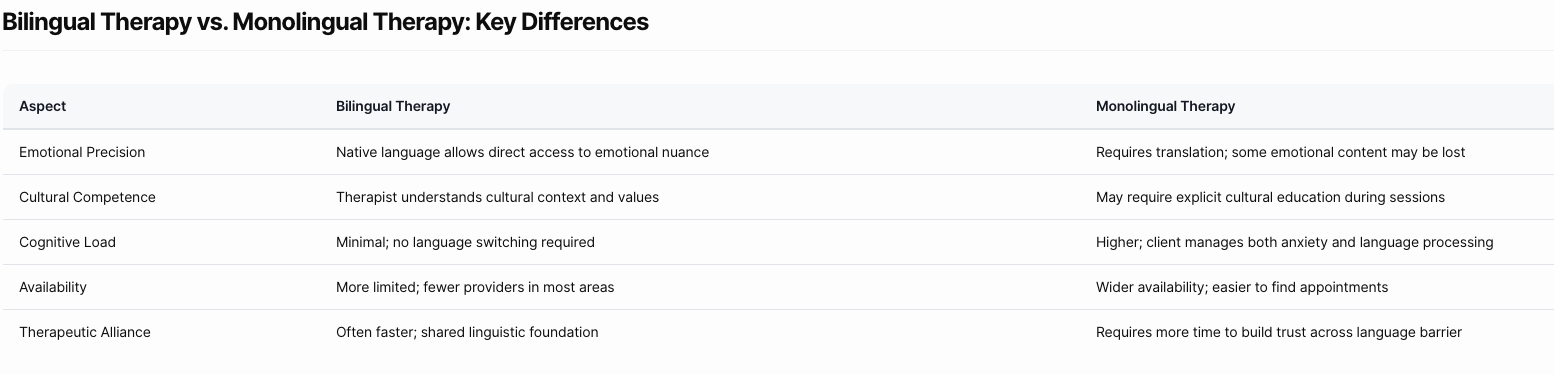
Bilingual Therapy vs. Monolingual Therapy: Key Differences
Cognitive Load and Language Switching
In bilingual therapy anxiety work conducted in a non-native language, your brain processes anxiety symptoms while translating internal experiences into a second language, a cognitive load with measurable effects on outcomes.
Language switching creates executive control demands, your brain activates different linguistic systems and manages vocabulary retrieval. For someone with anxiety, which already compromises executive function, this additional demand is exhausting.
Bilingual therapy for anxiety eliminates this friction, reducing cognitive load and freeing mental resources for emotional work, why many bilingual clients report feeling less drained after native-language sessions.
Therapeutic Alliance and Cultural Competence
The therapeutic alliance, the relationship between therapist and client, is the strongest predictor of therapy outcomes, shaped significantly by language and cultural competence.
A bilingual therapist who shares your language background brings cultural competence automatically, understanding the values, family dynamics, and cultural stressors that shape your anxiety, and recognizing when anxiety stems from acculturation stress or discrimination.
Studies show clients matched with culturally competent providers experience better outcomes and higher engagement. For bilingual individuals seeking bilingual therapy for anxiety, cultural competence and linguistic match often go hand in hand.
Finding a Bilingual Therapist for Anxiety
The practical challenge is access. Bilingual mental health providers are scarce, and finding someone who speaks your language, specializes in anxiety, and has availability can take months.
What to Look for in a Bilingual Provider
When evaluating a bilingual therapist for anxiety treatment, assess clinical proficiency in both languages, not just conversational ability. A therapist who speaks your language socially may lack the clinical vocabulary and cultural competence needed for therapy.
Look for therapists who explicitly state their bilingual training and experience. Ask whether they completed clinical training in both languages or only one. Therapists trained primarily in English but fluent in Spanish, for example, may lack the clinical terminology and cultural framework necessary for depth work in Spanish.
Specialization matters. Anxiety treatment has specific evidence-based approaches, cognitive-behavioral therapy, acceptance and commitment therapy, somatic therapies. A bilingual therapist should be trained in these modalities and able to deliver them in your native language, not just translate English protocols.
Cultural competence is learnable and should be explicit. Ask whether the therapist has training in trauma-informed care, acculturation stress, and immigration-related mental health. These specialized areas directly affect bilingual clients with anxiety.
Questions to Ask Before Starting
Before committing to bilingual therapy for anxiety, ask these questions:
About clinical training: "In which language did you complete your clinical training? Do you have specific training in treating anxiety disorders?" This clarifies whether the therapist's expertise translates across languages.
About bilingual experience: "How many bilingual clients with anxiety have you treated? What languages do you work in, and which is your primary clinical language?" Experience matters. A therapist who occasionally sees bilingual clients differs significantly from one who specializes in bilingual work.
About cultural competence: "What training have you completed in cultural competence, acculturation stress, or immigrant mental health?" This reveals whether the therapist can contextualize your anxiety within your cultural and linguistic reality.
About language switching: "If I want to switch languages during sessions, are you comfortable with that? How do you handle code-switching in therapy?" Some clients benefit from flexibility. Others prefer consistency. Know your preference and find a provider who supports it.
About confidentiality: "How do you ensure confidentiality when working across languages? Are there any language-specific limitations to confidentiality in your practice?" This matters, especially for clients from tight-knit communities where language creates identifiability.
Bilingual Therapy Platforms and Private Practice Options
Your options for bilingual therapy fall into two broad categories: large-scale platforms with networks of bilingual providers and specialized private practices. Each has distinct advantages and limitations.
Large-scale platforms like BetterHelp and Grow Therapy connect you with licensed therapists from extensive networks. BetterHelp starts at $65 per week and lets you filter for bilingual providers. Grow Therapy integrates insurance, which can reduce out-of-pocket costs. These platforms offer convenience and choice, but therapist availability varies by location and language pair.
Specialized platforms like Sanarai focus specifically on Spanish-speaking clients. Sanarai charges $25 for a first session, making entry affordable. The trade-off is limited language pairs, if you need a language beyond Spanish, these specialized platforms won't serve you.
Private practices like Wayfinder Counseling Therapy offer personalized care with deeper specialization.
Large-Scale Platforms vs. Specialized Private Practices
Large platforms prioritize access and convenience. You can start therapy within days. You have choices. But therapist continuity isn't guaranteed, and cultural specialization varies. A therapist on BetterHelp might be bilingual but lack expertise in anxiety or cultural competence specific to your background.
Barriers to Accessing Bilingual Mental Health Care
Despite growing demand, bilingual mental health services remain scarce. Several systemic barriers explain why.
Real Outcomes: What the Evidence Shows
The evidence on bilingual therapy for anxiety is still developing, but existing research points to clear patterns.
Frequently Asked Questions
Is bilingual therapy actually better for anxiety than monolingual therapy?
Bilingual therapy can be more effective when the therapist shares your native language and cultural background, particularly for anxiety disorders. Research shows that discussing trauma and emotional experiences in your native language reduces cognitive load, allowing you to access deeper emotional processing. However, effectiveness depends on finding a clinically proficient bilingual provider who understands both your language nuances and cultural identity. The therapeutic alliance, the relationship between you and your therapist, matters more than the modality itself.
What should I look for when finding a bilingual therapist for anxiety?
Seek a licensed mental health professional (LPC, LCSW, or psychologist) who is fluent in both languages and has specific training in anxiety disorders. Ask about their clinical experience with bilingual clients, their understanding of cultural competence, and whether they've worked with your specific anxiety presentation. Verify their credentials through your state's licensing board. Request a consultation to assess whether you feel heard and understood, psychological safety in your preferred language is essential for effective treatment.
How does the impact of language on emotional expression affect therapy outcomes?
Your native language is where emotions live most authentically. When you express anxiety in your native language, you access emotional memories, cultural context, and nuanced feelings that might be inaccessible in a second language. This linguistic nuance helps your therapist understand the true nature of your anxiety and tailor interventions accordingly. Conversely, discussing sensitive topics in a non-native language can create emotional distance and reduce the effectiveness of evidence-based practices like cognitive-behavioral therapy or trauma-informed care.
What barriers might prevent me from accessing bilingual mental health services for anxiety?
Common barriers include limited availability of bilingual providers in rural or underserved areas, insurance coverage gaps, cost of private-pay therapy, and difficulty verifying a provider's actual bilingual competency. Language barriers themselves can make it harder to describe your anxiety symptoms accurately. Additionally, acculturation stress and cultural stigma around mental health may delay seeking care. Virtual therapy platforms have expanded access, but finding a clinically proficient provider who specializes in anxiety still requires research and advocacy.
