Find Bilingual Therapist for Teens: 2026 Guide
Why Finding the Right Bilingual Therapist for Teens Matters
Finding a bilingual therapist for teens means creating a space where your adolescent feels fully understood in both language and cultural context. When a teen navigates anxiety, ADHD, or school stress, expressing themselves in their most comfortable language significantly impacts how quickly they engage in counseling. A therapist who shares their cultural background also helps reduce the mental health stigma that often prevents teens from seeking support.
This guide shows you how to evaluate your options, what questions to ask, and which directories can help you find a bilingual therapist for teens who fits your family's needs.
Key TakeawayA bilingual therapist for teens does more than translate; they bridge the gap between your teen's home culture and the broader world, which is essential for effective therapy.
Top Directories and Platforms to Find Bilingual Therapist for Teens
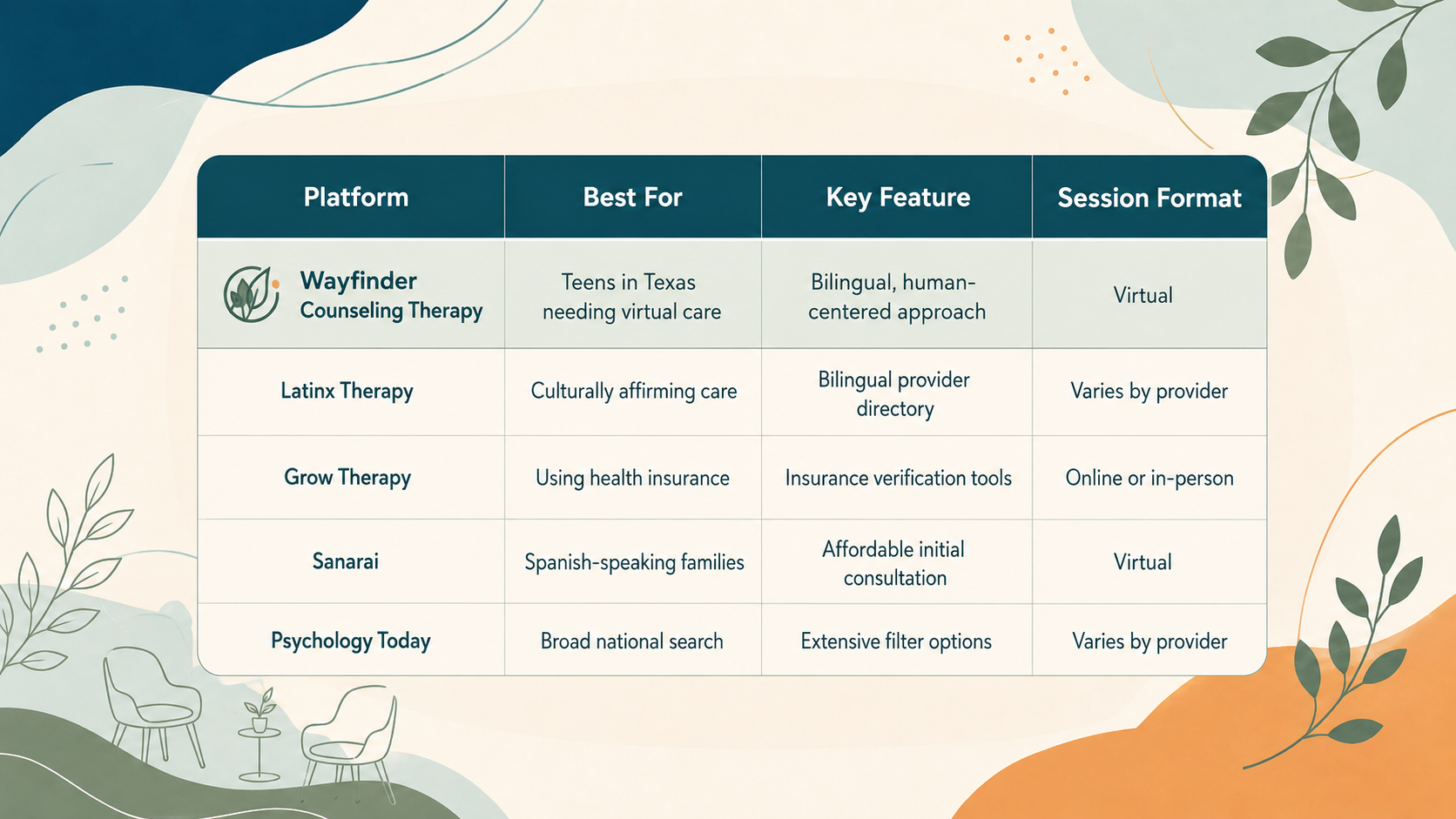
Wayfinder Counseling Therapy: Personalized Virtual Support in English and Spanish
Wayfinder Counseling Therapy, led by Julio Ibarra, LPC, offers bilingual virtual support for teens, young adults, and families in Texas. The practice focuses on understanding the individual before the problem, helping clients gain emotional clarity and improve family communication.
Virtual sessions make support accessible throughout Texas, including rural areas. The practice works well for teens comfortable in English who benefit from a provider understanding cultural household nuances.
Latinx Therapy: Specialized Directory for Culturally Affirming Care
Latinx Therapy is a specialized directory for culturally affirming, bilingual mental health professionals with filters for specialty, location, and insurance. They also provide mental health podcasts and educational resources.
Pricing varies by therapist, but the focus on cultural alignment makes it valuable for families prioritizing cultural fit.
Grow Therapy: Insurance-Focused Provider Network
Grow Therapy helps you find insurance-accepting therapists with advanced filtering by language and specialty, plus insurance verification tools to clarify coverage before booking.
Availability varies by state, but the platform is reliable for families in major metropolitan areas.
Sanarai: Affordable Spanish-Language Virtual Sessions
Sanarai provides virtual bilingual emotional support and therapy for Spanish-speaking families, ideal for teens preferring home-based sessions.
Sanarai is virtual-only, which may not suit families preferring in-person sessions, but it's valuable for Spanish-speaking families seeking accessible support.

Psychology Today Directory: Comprehensive National Search
The Psychology Today Directory is the largest therapist database, with extensive filters by language, insurance, and specialty, plus direct contact forms for outreach.
The tradeoff is manual outreach to verify availability, but the volume of options increases the likelihood of finding a match.
Community-Based Options: Bleuler and Sliding-Scale Services
Community-based options like the Bleuler Psychotherapy Center offer bilingual services with sliding-scale fees and accept Medicaid and Medicare.
These services are often limited to urban areas; rural families may need to explore telehealth or contact local community health centers for sliding-scale options.
Questions to Ask a Teen Therapist Before You Commit
Before scheduling, conduct an initial consultation with targeted questions to distinguish between a provider who speaks two languages and one who understands bicultural identity development clinically.
Clinical and Language-Specific Questions:
Ask about their experience with your teen's specific challenges and how they measure progress. Also ask: "How do you approach code-switching in therapy?" A competent bilingual therapist supports code-switching as a normal skill that helps teens express themselves authentically, rather than forcing monolingual sessions.
Ask about training in acculturation stress, the strain from navigating conflicting values between home and broader culture. A strong answer references specific frameworks for understanding how family expectations differ across cultural contexts.
Confidentiality and Parental Involvement Boundaries:
Ask about confidentiality policy and parental involvement. A competent therapist explains that teens have privacy rights while recognizing parents' need for progress updates. Ask how they balance this: regular check-ins, what information is shared, and frequency of family sessions.
Red flags: therapists who promise complete secrecy or share detailed content without the teen's input. The best approach is collaborative, with the therapist helping the teen decide what parents learn.
Language Proficiency and Therapeutic Competence:
Confirm they can conduct therapy effectively in your teen's language. Ask what percentage of their caseload they see in that language and how they stay current with clinical terminology. Mental health concepts have specific meanings that don't always translate directly.
Ask if they're comfortable with code-switching within sessions. Some therapists insist on one language per session, which can feel unnatural for teens whose brains naturally operate in both languages.
Experience With Immigrant and Bicultural Family Dynamics:
If your family has an immigration background, ask about experience with immigrant families and understanding of intergenerational trauma, acculturation gaps, or undocumented status stressors. A therapist with this expertise will articulate it clearly.
Watch OutAvoid therapists who cannot clearly articulate their approach to confidentiality, parental involvement, code-switching, or acculturation stress. Vague answers often signal a lack of specialized training in bilingual adolescent therapy.
Culturally Competent Therapy for Teens: What to Look For
Culturally competent therapy goes beyond language. Look for providers who understand racial identity, family systems, and multiple cultures, integrating your family's values into treatment plans.
A culturally responsive therapist explores how racial identity and neurodivergence intersect with mental health, rather than attributing struggles solely to cultural conflict. Ask how they adapt evidence-based techniques to a bicultural context.
Virtual Bilingual Counseling for Adolescents: Benefits and Logistics
Virtual bilingual counseling offers distinct advantages: teens feel more comfortable discussing sensitive topics from home, and it removes geographic barriers for rural families.
Virtual sessions require stable internet and a private space. Ask about platform security measures to ensure confidentiality. Virtual counseling significantly expands the pool of qualified therapists for families unable to find in-person providers.
How to Evaluate Fit: Matching Your Teen With the Right Provider
Patient-provider fit is the most important predictor of therapy success. Schedule an initial consultation and observe whether the therapist shows genuine curiosity about your teen's world.
Don't focus only on qualifications; ask your teen how they felt and take their feedback seriously. Try a few sessions before deciding, as initial meetings focus on building rapport.
Book a free 15-minute consultation →
Insurance, Payment, and Financial Assistance Options
Private Pay and Direct-to-Provider Models:
Many bilingual therapists operate on private pay, avoiding insurance delays and session limits. Some offer reduced rates for weekly commitments or sliding scales based on income.
Ask directly about sliding scales based on income; many therapists offer them but don't advertise. Some reserve reduced-fee slots for lower-income clients.
Insurance-Based Care and Verification:
Use platforms like Grow Therapy and Psychology Today to filter by insurance and verify coverage. Ask therapists to verify benefits before your first session to prevent surprise bills and clarify session limits.
Many insurance plans require a diagnosis code before covering therapy. Ask whether the therapist is in-network (negotiated rates, insurance billing handled) or out-of-network (you pay upfront and submit claims).
Medicaid and Public Insurance Programs:
Community health centers and FQHCs accept Medicaid and offer bilingual services on a sliding-scale based on income. Find them through your state's Medicaid office or the HRSA Find a Health Center tool.
Availability of bilingual providers varies by state and region; urban areas and states with large Spanish-speaking populations have more options. If your local FQHC lacks bilingual staff, ask for referrals or telehealth options.
State-Funded and Community-Based Programs:
Many states fund free or low-cost adolescent mental health services through state departments of mental health. Contact your state's Department of Mental Health or county mental health authority for referrals to bilingual providers.
Some states fund school-based mental health services. Ask your teen's school counselor whether they speak your language or can refer you to a bilingual provider.
Nonprofit and Sliding-Scale Clinics:
Search online for "sliding scale therapy [your city]" or contact NAMI for directories of local nonprofit mental health resources offering affordable bilingual options.
University psychology and counseling programs often offer therapy clinics with graduate students under supervision at reduced rates. Ask whether they have bilingual clinicians.
Employer and Educational Benefits:
Check your employer plan for an Employee Assistance Program (EAP) offering free counseling sessions and bilingual referrals. College student health services also provide free or low-cost mental health care.
Cost Comparison and Planning:
Gather cost information from at least three options: insurance-based, private pay, and community health center. This comparison clarifies what's realistic for your budget. Some families combine approaches, using insurance for ongoing therapy and supplementing with specialized providers for specific issues.
Pro TipWhen contacting any provider, always ask directly about sliding scale, reduced fees, or financial assistance programs. Many therapists offer these options but do not advertise them publicly.
Conclusion: Taking the First Step
Finding the right bilingual therapist requires patience, but the effort pays off. Start with the directories above, ask the right questions, and trust your teen's instincts. The goal is a provider with both clinical expertise and cultural understanding.
Wayfinder Counseling Therapy offers a personalized, human-centered approach that has helped teens across Texas gain control over anxiety, improve communication with their parents, and develop practical techniques for managing stress. Led by Julio Ibarra, LPC, the practice provides virtual sessions in English and Spanish, specializing in teens, young adults, and parent support. Book a free 15-minute consultation to see if this is the right fit for your family.
Frequently Asked Questions
What questions should I ask a teen therapist during an initial consultation?
Ask about their experience with your teen's specific issues (anxiety, ADHD, school stress), their therapeutic approach, how they involve parents, confidentiality limits, and their language proficiency if bilingual services matter. Request clarity on how they measure progress and what to expect in early sessions. For teens, ask whether the therapist has experience with adolescent development and whether they create a safe space for teens to speak openly. These conversations help you gauge whether the therapeutic alliance will work for your teen.
What does culturally competent therapy for teens actually mean?
Culturally competent therapy means the therapist understands and respects your teen's cultural background, family values, and lived experiences. For bilingual teens, this includes recognizing how cultural identity, immigration status, or bicultural experiences affect mental health. A culturally competent therapist avoids making assumptions, asks about your teen's cultural context, and integrates that understanding into treatment. They may also be aware of mental health stigma in certain communities and help your teen navigate that. This approach often leads to better outcomes because teens feel truly heard, not just treated.
Are there financial assistance options if therapy is out of pocket?
Yes. Many community mental health centers offer sliding-scale fees based on income, making therapy more affordable for families. Some platforms like Sanarai offer lower per-session costs. If your teen qualifies for Medicaid, you can find providers who accept it through directories like Grow Therapy or Psychology Today. Some private practices also offer payment plans. Wayfinder Counseling Therapy offers a free 15-minute consultation to discuss your situation and explore options. Contact providers directly to ask about financial assistance programs.
Can virtual bilingual counseling for adolescents be as effective as in-person therapy?
Yes, research shows virtual therapy can be as effective as in-person sessions, especially for teens who prefer digital communication or live in areas with limited provider access. Virtual bilingual counseling removes language and transportation barriers while maintaining the therapeutic relationship. However, effectiveness depends on your teen's comfort level with video, a private space for sessions, and a strong connection with the therapist. Some teens thrive in virtual settings; others prefer in-person. During your consultation, discuss which format suits your teen best.
